
printing / contour milling
Direct UV printing on PVC boards combined with digital contour cutting is the standard for modern visual advertising. Discover a process that eliminates the need for film gluing, guaranteeing photographic quality and perfect shape adjustment.
UV printing on PVC boards is commonly used in the advertising industry, e.g. in the production of spatial advertising media. Until recently, you had to print on self-adhesive film, and then stick this film on plates. Currently, thanks to the possibility of printing on rigid substrates, this stage can most often be omitted. Cost and time savings are obvious, which is of utmost importance in advertising. Elements made of printed PVC are insensitive to UV rays and mechanically resistant. They are also easy to machine, thanks to which, for example, CNC milling for complex shapes is not a problem.
the technology: UV printing and optical positioning
UV printing on rigid substrates such as foamed PVC (but also rigid PVC, acrylic, polycarbonate, and aluminium composite panels) is a revolutionary technology. By curing the ink with ultraviolet light, the print is instantly dry and resistant to weather conditions and mechanical damage. A key element of the B52 process is the optical positioning system. A camera integrated with the CNC milling machine reads the printed registration marks, allowing:
- aligning the cutting line with the graphic (even with slight material misalignment),
- cutting complex, openwork shapes,
- creating repeatable product series with the highest precision.
CNC contour milling: why is it worth it?
Unlike traditional methods, CNC milling allows for the processing of materials of considerable thickness while maintaining clean and smooth edges.
- Eliminating films: Eliminating the need for printing on film and then gluing the film to boards reduces costs and production time.
- Durability: No risk of graphics delaminating due to temperature or humidity.
- Freeform: From simple information boards to advanced POS display elements and 3D letters.
Technical guide: how to prepare files for printing and milling?
To achieve the best results and speed up order processing, files should meet the following parameters:
- Vector file format (e.g., PDF),
- Layers: The design should contain two layers: a graphic layer and a layer describing the cutting line as an outline, marked in a spot colour different from the graphic.
- Bleeds: Due to the nature of mechanical processing, a minimum 1-3 mm bleed of the graphic beyond the cutting line is required.
- Safety margin: Important text elements and logos should be placed at a safe distance from the milling line.
Registration and crop marks: Please do not include your own crop marks – our system automatically generates them during the pre-print stage.
Looking for a contractor who combines print quality with milling precision? Contact us and submit your project for a quote.
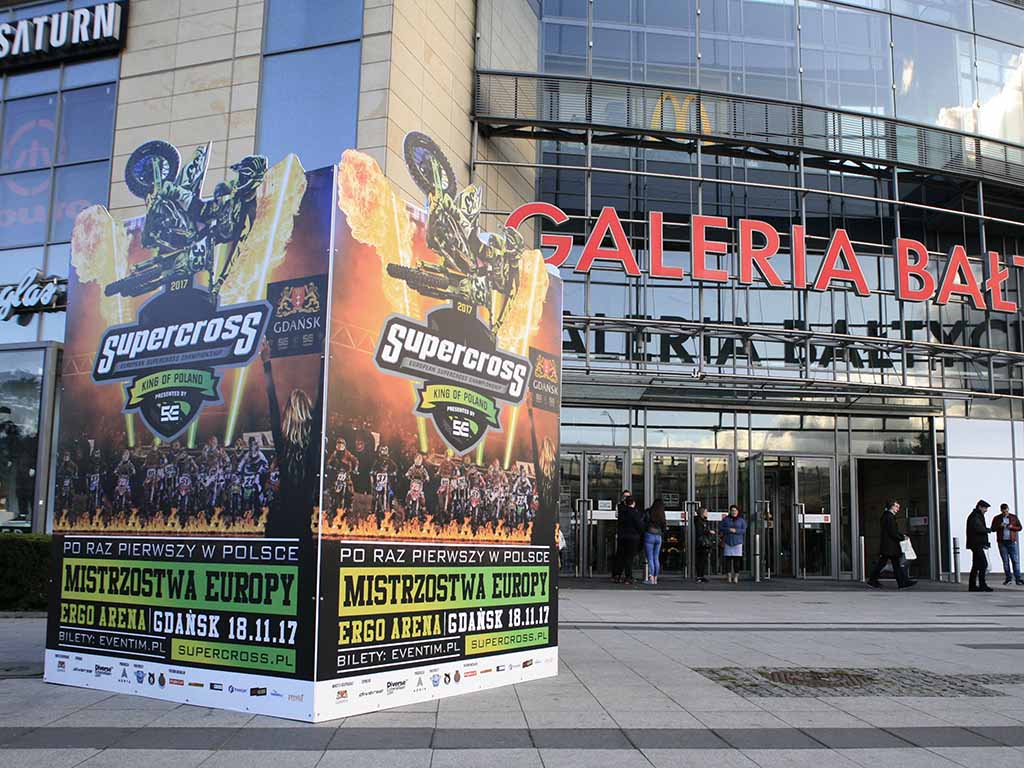
In the photo: direct UV printing on PVC boards. Optical positioning, contour milling.
See also: printing on PVC